plars
Principle
It is uselful to understand the principle of the plars algorithm as this paves the way to a better understanding of the input arguments involved in the modules’ call.
A more detailed presentation is provided in (Alamir, 2025).
1 Principle of the plars algorithm
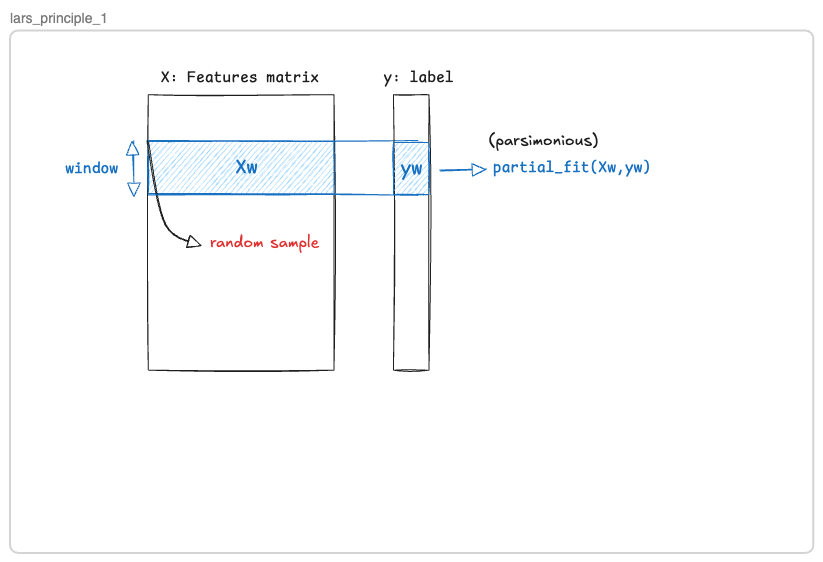
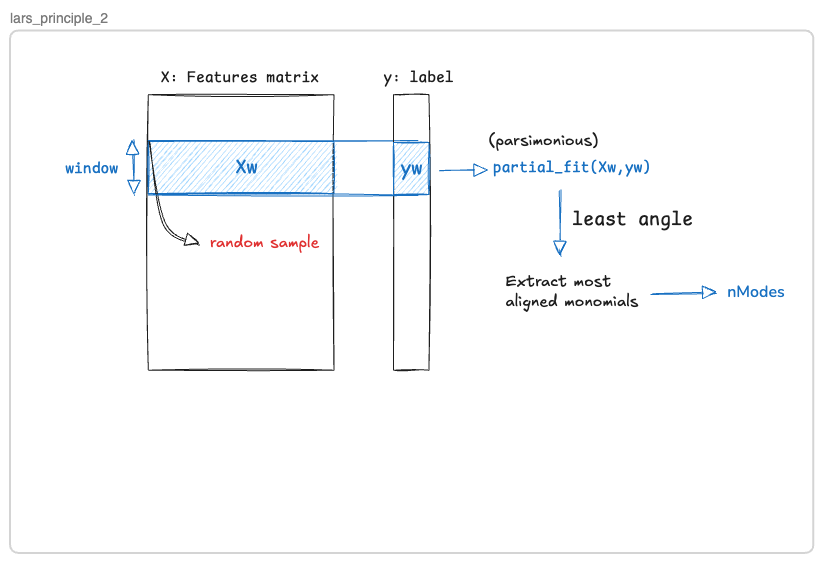
nModes most aligned monomials with \(y_w\).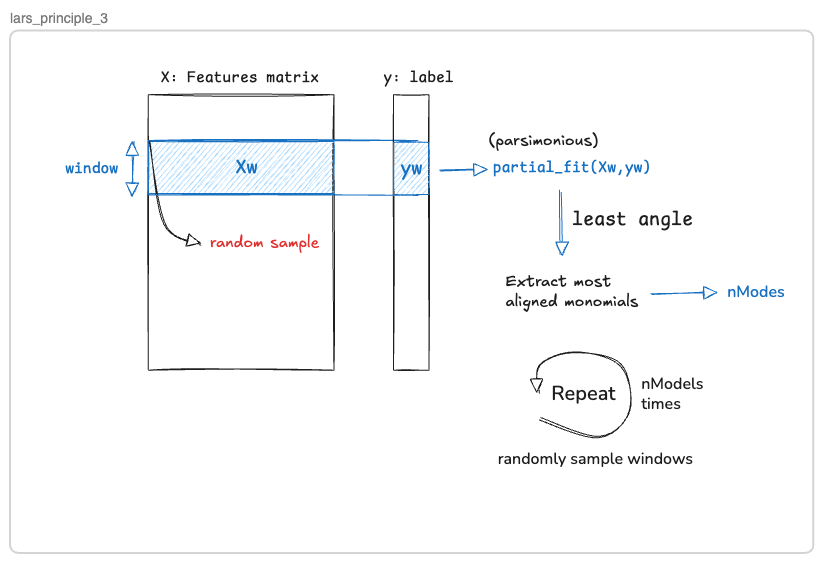
nModels times.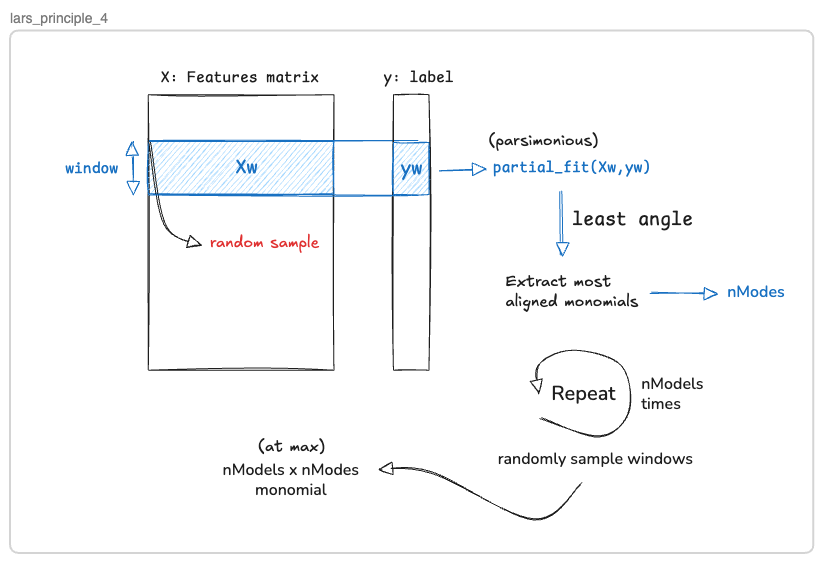
nModels x nModes selected monomials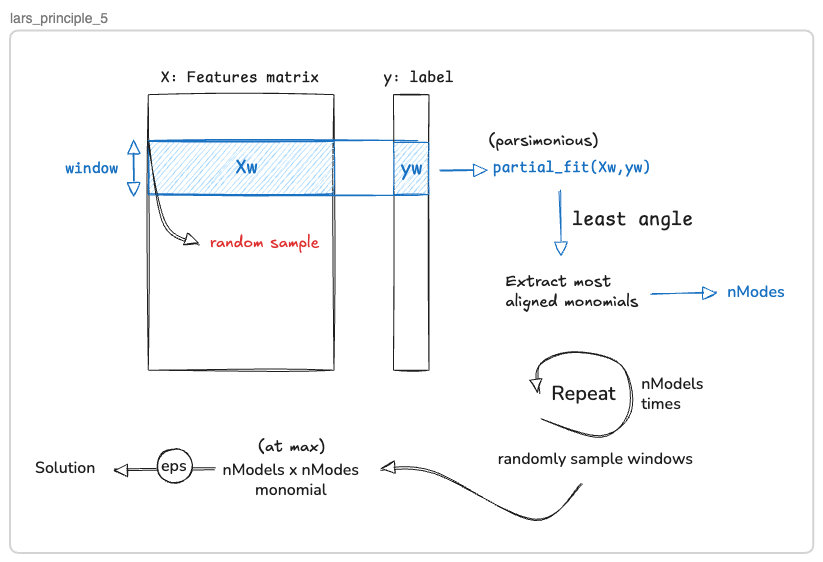
eps.The following features come out directly from the principle sketched above:
The process inside plars involves an amount of randomness due to the randomly selected nModels windows. Consequently, the solution returned is never rigorously the same. This is totally intentional.
Notice however that the random windowing process that leads to only a partial covering of the dataset is in the heart of the scalability of plars. This can only be done if parsinomious search is used, otherwise the risk of overfitting would be too high.
2 Input arguments
From the above principle, it comes clearly that the call of plars need the following arguments to be provided:
X- Feature matrix
y- Label vector
window- The size of the window (integer) representing the number of subsequent rows to be selected for the current partial fit.
deg- The degree of the polynomials used in the monomial selection process.
nModes- Number of monomials to be extracted at each partial fit.
nModels- Number of repeated rounds of random selection of working window.
eps- Targeted precision impacting the number of monomials retained in the final solution.
These are the input arguments that directly follows from the principle of the plars modules, other arguments are also possible to use in order to orient the execution towards some specific objective.
Further description of the input arguments is provided in the example.
3 Returned solution
Notice that according to the principle exposed above, the solution consists in the list of monomials with their associated coefficients. This is precisely what is needed to define the sparse multivariate polynomial, solution of the regression problem stated in Problem statement section.
As a matter of fact, the returned solution, say sol is a dictionary that contains many keys, among them, powers and coefs are available to represent the fitted polynomial.
Further description of the returned solution is provided in the next section that proposes a simple illustrative example.