Polynomials
A reminder on multi-variate polynomials’ notation and related modules
In this section, we recall some definitions related to multi-variate polynomials as the latter are in the heart of the mizopol package.
1 Definition
- Let us assume that \(x\in \mathbb R^n\) is an \(n\)-dimensional vector of features.
- A multivariate1 polynomial in \(x\) is a scalar map \(P(x)\) that takes the following form:
\[ P(x)=\sum_{i=1}^{n_c} c_i\phi_i(x)\quad\text{where}\quad \phi_i(x) = \prod_{j=1}^{n}x_j^{p_{ij}} \tag{1}\]
where each \(\phi_i\) in Equation 1 is called a monomial.
- The degree of monomial \(\phi_i\) is defined by the sum of its powers, namely:
\[ \texttt{deg}(\phi_i) = \sum_{j=1}^{n}p_{ij} \tag{2}\]
- The degree of the polynomial is the maximum degree of its monomial, namely:
\[ \texttt{deg}(P) = \max_{i=1}^{n_c}\Bigl[\texttt{deg}(\phi_i)\Bigr] \tag{3}\]
2 Representation
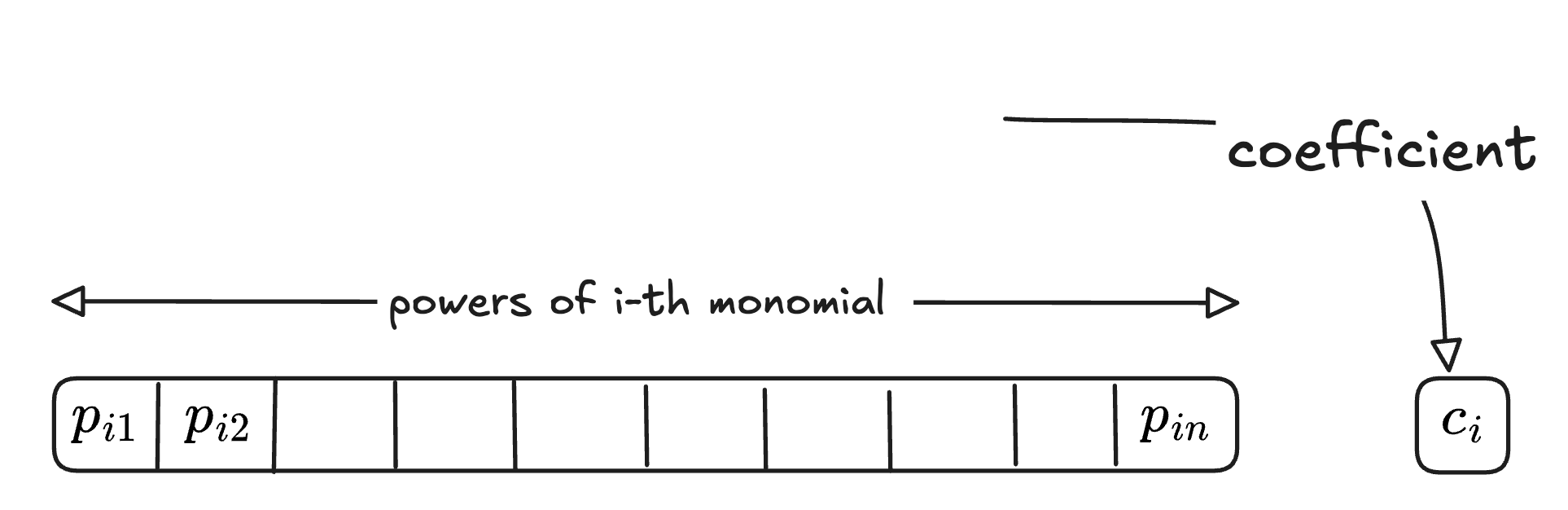
From the very definition of a monomial \(\phi_i\), it comes out that its contribution to the expression of the polynomial \(P\) is entirely defined by the following attributes:
- The vector of powers \(p_{ij}\) for \(j\in \{1,\dots,n\}\) (these are integers)
- The coefficient \(c_i\) that is associated to the monomial
In other words, the information associated to \(\phi_i\) takes the following form:
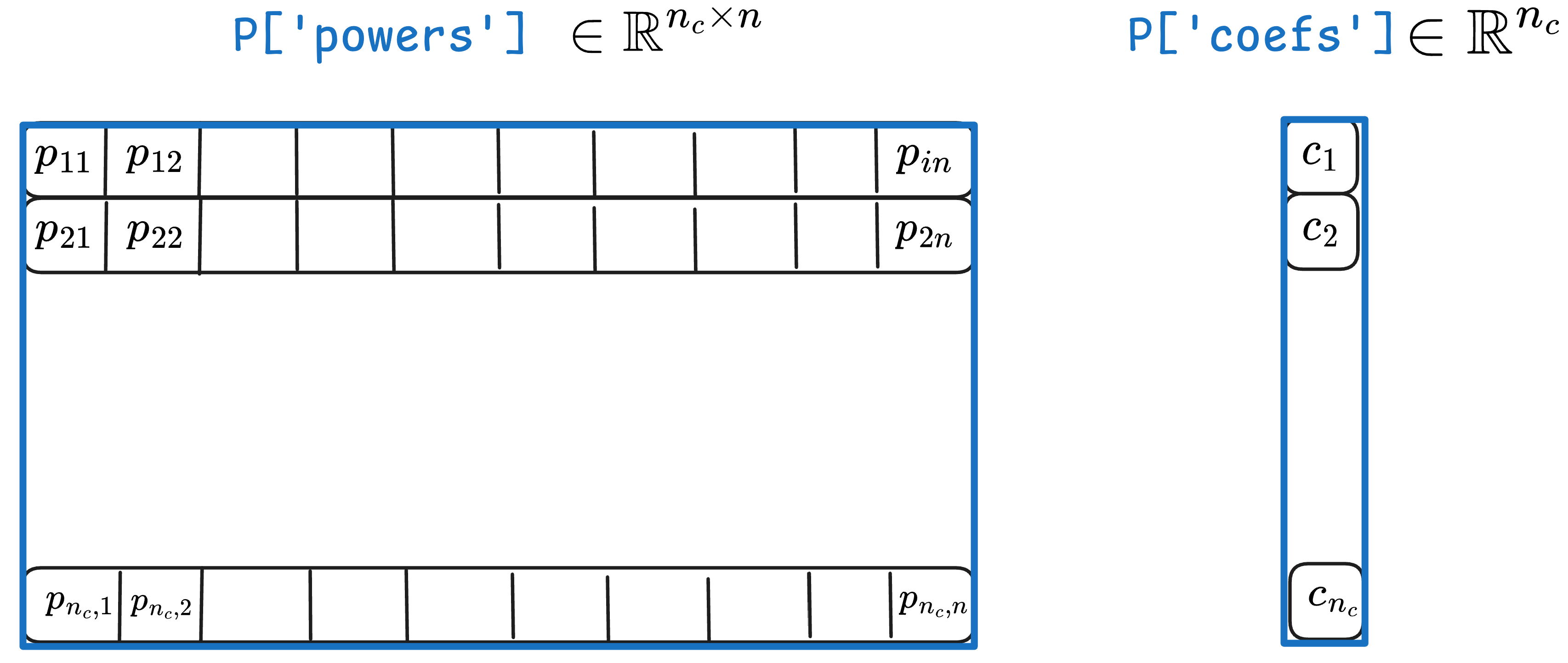
Now since the polynomial \(P\) involves \(n_c\) monomials, it comes out that \(P\) is totally determined by its power matrix and its associated vectors of coefficients as it is shown in the following figure (see also Equation 1):
Footnotes
We shall drop the word multivariate in the sequel.↩︎