xpwpol
Explicit piece-wise polynomial representation.
Unlike the implicit relationships provided by the pwpol module which can only provides normality residuals, Explicit piece-wise polynomial representations provide explicit prediction of a label.
This prediction is generally more precise that the one provided by a single polynomial explicit representation returned by plars. On the other hand, when used only to compute normality residuals, it might be less tight than the one provided by the pwpol implicit represenation.
The explicit relationship provided by the xpwpol module takes the following form:
\[ \hat y = \dfrac{1}{n_v} \sum_{\kappa=1}^{n_v}P_{\sigma(x\vert \kappa)}(x)\quad \text{where}\quad \sigma(x\vert \kappa)\in \{1,\dots,n_r\} \tag{1}\]
The computation architecture that is adopted inisde the xpwpol module is schematically shown in the Figure below:
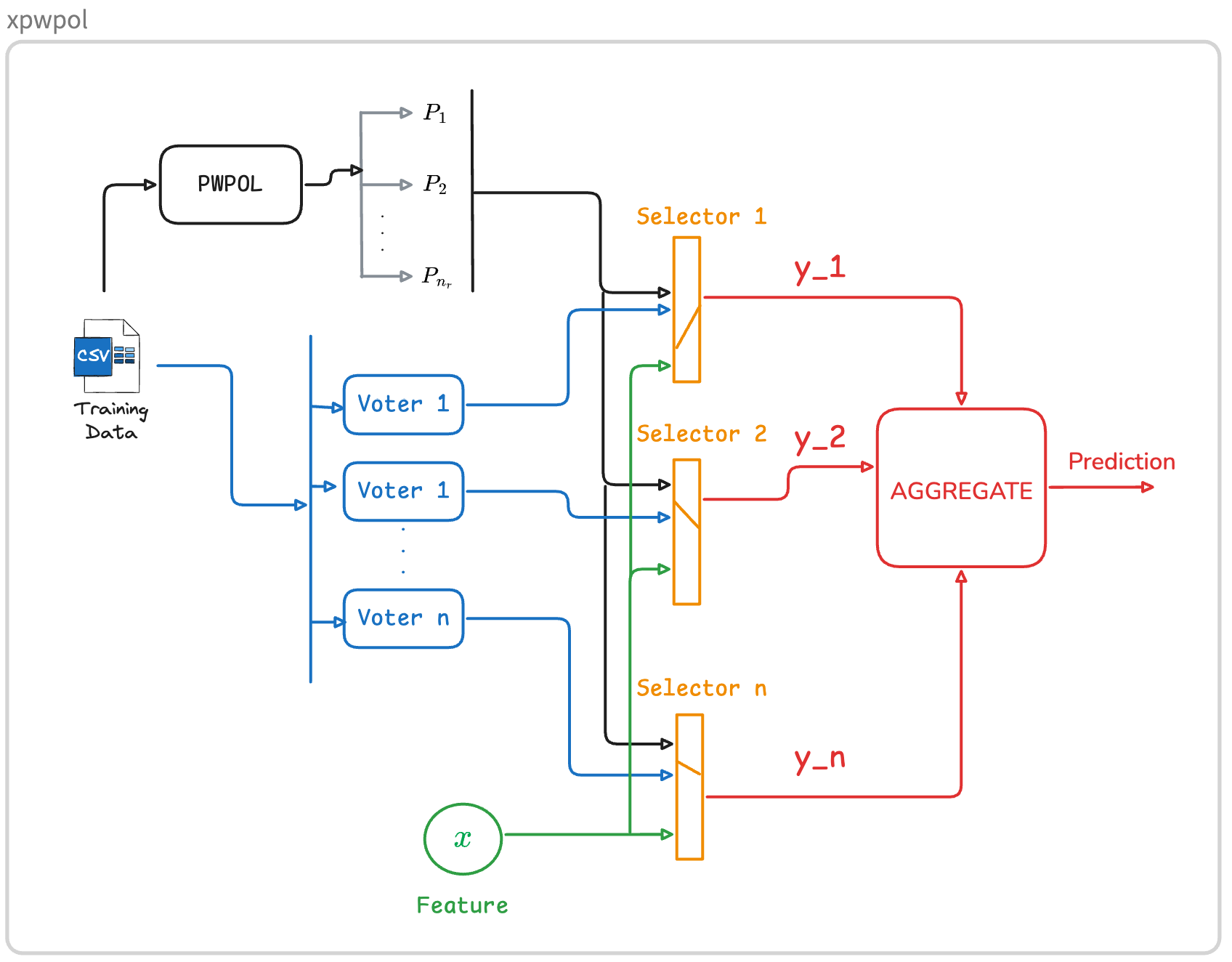
More precisely:
The module uses the
pwpolmodule to compute a reduced number of multi-variate polynomials (\(P_i\), \(i=1,\dots,n_r\)) which captures the relationships in different regions of the features spaces. The issues is that it generally impossible to compute a high fidelity regions’ classifiers.Here is where the
xpwpolattempts a heuristic solution encompassing an amount of randomness in order to define multiple voters. Each of these voters possess a partitioning tools that decomposes the featurs spaces in a scalable way providing for each sub-region a specific choice of the polynomial to be used. This mechanism is represented in Figure 1 by the selectors (in orange).For any new (unseen) given vector of features, each of the voter provides an estimation
y_iof the label which are then aggregated to provide the final estimation.
More details on the associated API and the available tuning parameters are provided in the related API-documentation section.